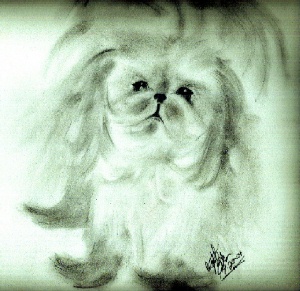
Revised
Standard for the Pekingese
The
Board of Directors of The American Kennel Club has approved the following
revised standard for the Pekingese as submitted by the Pekingese Club of
America, Inc.
General Appearance
The Pekingese is a well-balanced, compact dog with heavy front and lighter
hindquarters. It must suggest its Chinese origin in its directness,
independence, individuality and expression. Its image is lion like. It should
imply courage, boldness and self-esteem rather than prettiness, daintiness or
delicacy.
Size, Substance, Proportion
Size/Substance The Pekingese should
be surprisingly heavy when lifted. It has a stocky, muscular body. The bone of
the forequarters must be very heavy in relation to the size of the dog. All
weights are correct within the limit of 14 pounds, provided that type and points
are not sacrificed. Disqualification: weight over 14 pounds. Proportion The length of the body, from the front of the breast
bone in a straight line to the buttocks, is slightly greater than the height at
the withers. Overall balance is of utmost importance.
Head
Skull The topskull is massive, broad
and flat (not dome-shaped). The topskull, the high, wide cheek bones, broad
lower jaw and wide chin are the structural formation of the correctly shaped
face. When viewed frontally, the skull is wider than deep and contributes to the
rectangular envelope-shaped appearance of the head. In profile, the Pekingese
face must be flat. The chin, nose leather and brow all lie in one plane. In the
natural position of the head, this plane appears vertical but slants very
slightly backward from chin to forehead. Nose It is black, broad, very short and in profile, contributes to
the flat appearance of the face. Nostrils are open. The nose is positioned
between the eyes so that a line drawn horizontally across the top of the nose
intersects the center of the eyes. Eyes
They are large, very dark, round, lustrous and set wide apart. The look is bold,
not bulging. The eye rims are black and the white of the eye does not show when
the dog is looking straight ahead. Wrinkle It effectively separates the upper and lower areas of the
face. The appearance is of a hair covered fold of skin, extending from one
cheek, over the bridge of the nose in a wide inverted "V", to the
other cheek. It is NEVER so prominent or heavy as to crowd the facial features
nor to obscure a large portion of the eyes or the nose from view. Stop
It is deep. The bridge of the nose is completely obscured from view by hair
and/or the over-nose wrinkle. Muzzle
This is very short and broad with high, wide cheek bones. The color of the skin
is black. Whiskers add to the Oriental expression.Mouth
The lower jaw is slightly undershot. The lips meet on a level plane and neither
teeth nor tongue show when the mouth is closed. The lower jaw is strong, wide,
firm and straight across at the chin. An excessively strong chin is as
undesirable as a weak one.Ears They
are heart-shaped and set on the front corners of the skull extending the line of
the topskull. Correctly placed ears frame the sides of the face and with their
heavy feathering create an illusion of additional width of the head.Pigment
The skin of the nose, lips and eye rims is black on all colors.
Neck, Body, Tail
Neck It is very short, thick and set
back into the shoulder. Body This is
pear-shaped and compact. It is heavy in front with well-sprung ribs slung
between the forelegs. The broad chest, with little or no protruding breast bone,
tapers to lighter loins with a distinct waist. The topline is level. Tail
The base is set high; the remainder is carried well over the center of the back.
Long, profuse straight feathering may fall to either side.
Forequarters
They are short, thick and heavy-boned. The bones of the forelegs are slightly
bowed between the pastern and elbow. Shoulders are gently laid back and fit
smoothly into the body. The elbows are always close to the body. Front feet are
large, flat and turned slightly out. The dog must stand well up on feet.
Hindquarters
They are lighter in bone than the forequarters. There is moderate angulation and
definition of stifle and hock. When viewed from behind, the rear legs are
reasonably close and parallel and the feet point straight ahead. Soundness
is essential in both forequarters and hindquarters.
Coat
Body Coat It is full-bodied, with
long, coarse textured, straight, stand-off coat and thick, softer undercoat. The
coat forms a noticeable mane on the neck and shoulder area with the coat on the
remainder of the body somewhat shorter in length. A long and profuse coat is
desirable providing that it does not obscure the shapeliness of the body, nor
sacrifice the correct coat texture. Feathering
Long feathering is found on the back of the thighs and forelegs, and on the
ears, tail and toes. The feathering is left on the toes but should not be so
long as to prevent free movement.
Color
All coat colors and markings, including parti-colors, are allowable and of equal
merit.
Gait
The gait is unhurried and dignified, with a slight roll over the shoulders. The
rolling gait is caused by the bowed front legs and heavier, wider forequarters
pivoting on the tapered waist and the lighter, straight parallel hindquarters.
The rolling motion is smooth and effortless and is as free as possible from
bouncing, prancing or jarring.
Temperament
A combination of regal dignity, self-importance, self-confidence and
exasperating stubbornness make for a good natured, lively and affectionate
companion to those who have earned its respect.
The foregoing is a description of the ideal Pekingese. Any deviation should be
penalized in direct proportion to the extent of that deviation